

Connecting CRM with Your Website: The Benefits of Seamless Integration
Your CRM is one of the most powerful tools in your business — a system that centralizes customer data and gives your team everything they need to build stronger, smarter relationships.
But modern businesses don’t operate from one system alone. You collect data through your website, marketing platforms, landing pages, eCommerce tools, support systems, finance software, legacy databases, and countless third-party apps.
The challenge?
Most companies struggle to keep all these tools connected — and information ends up scattered across different platforms.
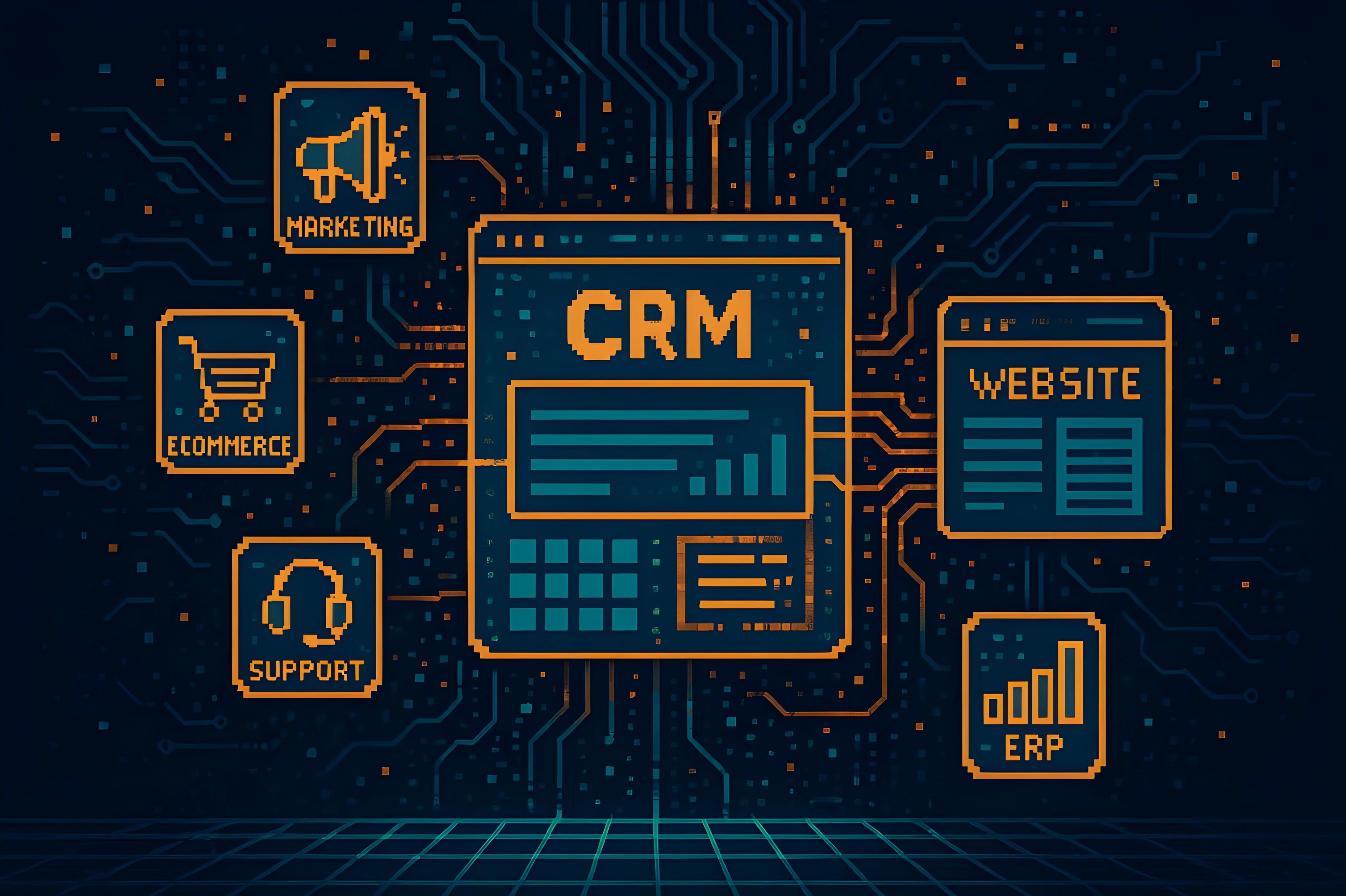
CRM integration solves this by connecting your website and external applications directly to your CRM, turning it into a single source of truth for your entire organization.
Let’s break down what CRM integration is, why it matters, and how it helps companies operate more efficiently.
What Is CRM Integration?
CRM integration is the process of connecting your CRM with other software — your website, ERP, marketing tools, payment systems, communication platforms, databases, and any third-party applications your team uses.
Once integrated, data flows automatically between systems.
For example:
-
A website form submission instantly appears as a new lead in your CRM
-
An online purchase updates the customer’s profile and inventory in real time
-
A marketing campaign records engagement directly into CRM
-
Support requests sync into the customer’s timeline
Integration eliminates manual work and ensures everyone uses the same, accurate data.
Why CRM Integration Matters
Most companies rely on dozens (sometimes hundreds) of separate applications.
Without integration, each tool operates in isolation — creating data silos, duplicated work, and inconsistent customer information.
CRM integration breaks these silos by bringing all data together in one unified ecosystem.
Here’s why it’s essential:
5 Key Benefits of Connecting Your CRM With Your Website and External Systems
1️⃣ Better Collaboration Across All Departments
When sales, marketing, customer service, finance, and operations use one connected CRM:
-
Everyone sees the same customer information
-
Updates appear in real time
-
Teams communicate faster and make better decisions
No more switching between systems or manually updating spreadsheets — just one centralized, accurate dataset.
2️⃣ More Efficient Workflows and Higher Productivity
Disconnected tools slow teams down.
Integrated CRM systems:
-
eliminate repetitive manual data entry
-
reduce the need to log into multiple platforms
-
streamline task management and follow-ups
-
help teams focus on meaningful work instead of admin tasks
Add AI capabilities on top, and your CRM can automate responses, generate insights, and recommend next actions.
3️⃣ More Accurate Data + Stronger Analytics
When customer data flows automatically from every connected system, your CRM becomes the most accurate version of your business information.
This means:
-
cleaner customer profiles
-
fewer errors
-
real-time updates
-
richer analytics and reports
Retail, logistics, and service companies especially benefit from real-time inventory, order, and delivery data inside their CRM.
4️⃣ Higher Sales and Better Lead Management
A website that’s integrated with your CRM can automatically push:
-
form submissions
-
checkout data
-
abandoned cart information
-
newsletter signups
-
campaign engagement
…directly into your CRM pipeline.
Sales teams get better-qualified leads.
Marketing teams get accurate data for segmentation.
eCommerce teams get a full customer journey view.
This leads to higher conversion rates and faster sales cycles.
5️⃣ Better Customer Service and Faster Support
When CRM is integrated with your website’s support tools — chat widgets, ticket systems, help centers — your support team gets a complete view of each customer:
-
purchase history
-
previous issues
-
notes from sales
-
marketing interactions
-
account details
Agents resolve issues faster.
Digital agents and chatbots provide more accurate answers.
Customers enjoy a smoother experience.
How CRM Integration Works: The Role of APIs
APIs (Application Programming Interfaces) are the technology that enables different systems to communicate.
With APIs, you can:
-
connect modern cloud platforms
-
integrate legacy systems
-
automate data syncing
-
build custom interactions between tools
A strong API strategy ensures your CRM remains the central hub for all customer data — no matter how many apps your business uses.
Three Main API Types Used in CRM Integration
-
System APIs – pull raw data from specific systems (ERP, payments, shipping, billing).
-
Process APIs – combine multiple systems into one unified workflow (e.g., shipping + order status).
-
Experience APIs – prepare data for specific users (sales dashboards, service consoles, customer portals).
Companies that follow an API-led approach achieve faster development, smoother integrations, and cleaner data infrastructure.
Final Thoughts: A Connected CRM = A Smarter Business
Integrating your CRM with your website and external applications turns your CRM into the true heartbeat of your business — a unified platform where data, processes, and teams come together.
You gain:
✔ better collaboration
✔ richer insights
✔ more accurate data
✔ higher productivity
✔ stronger customer experiences
✔ increased sales
The result is a more connected, intelligent, and scalable business.