

The ROI of Automation: What Really Matters
Automation has become a strategic priority for growing businesses—but one question continues to dominate the conversation: what is the real return on investment?
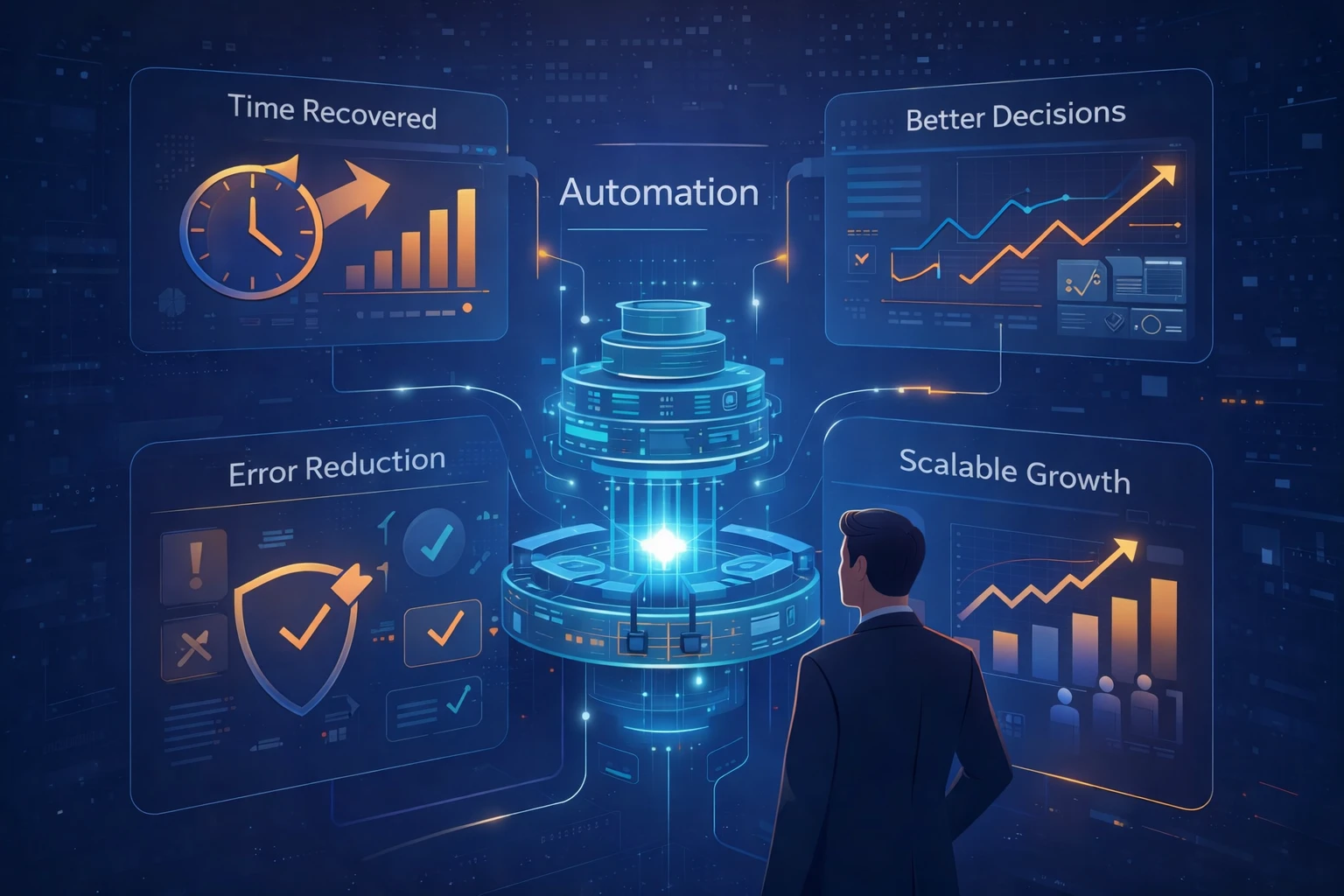
Too often, ROI is calculated purely in terms of cost savings or headcount reduction. While these metrics are easy to measure, they capture only a fraction of automation’s true value. The most meaningful returns appear elsewhere: in time recovered, accuracy improved, scalability unlocked, and decisions made faster and with greater confidence.
Why Traditional ROI Metrics Miss the Point
Many organizations assess automation by asking how much labor it can replace or how much money it can save. This narrow lens overlooks the real purpose of automation.
Automation is not about replacing people—it’s about elevating how people work.
When ROI is viewed only through direct cost reduction, businesses underestimate automation’s impact and delay initiatives that could fundamentally improve how they operate.
1. Time Recovered: The Most Valuable Return
Time is one of the few resources that cannot be scaled manually. Automation recovers hours lost to repetitive tasks, approvals, data entry, and manual coordination.
With automated workflows, organizations can:
-
Eliminate process bottlenecks
-
Accelerate execution
-
Redirect employee effort toward high-impact work
Recovered time fuels faster growth, quicker customer response, and greater operational agility—returns that compound over time.
2. Error Reduction and Process Consistency
Manual processes are inherently prone to mistakes, inconsistencies, and rework. Even minor errors can accumulate into significant financial, operational, or reputational costs.
Automation delivers:
-
Consistent execution
-
Fewer human errors
-
Stronger compliance and auditability
While the ROI of avoided mistakes may not be immediately visible, its long-term value is substantial.
3. Faster, Better Decision-Making
Automation doesn’t just improve execution—it transforms decision-making. When systems automatically collect, validate, and analyze data, leaders gain real-time visibility into their operations.
This enables:
-
Immediate access to reliable data
-
Automated alerts and insights
-
Faster, more confident decisions
Decisions made earlier and with better information often deliver far greater impact than short-term savings alone.
4. Scalability Without Linear Growth
One of the strongest indicators of automation ROI is the ability to scale without increasing complexity or headcount at the same rate.
Automation allows businesses to:
-
Handle higher volumes without proportional staffing increases
-
Maintain quality as operations grow
-
Absorb growth without operational strain
This creates a stable foundation for predictable, sustainable expansion.
5. Employee Satisfaction and Retention
Repetitive manual work is a major driver of burnout and disengagement. Automation removes unnecessary friction from daily tasks, allowing teams to focus on strategic, creative, and meaningful work.
The result is:
-
Higher job satisfaction
-
Improved employee retention
-
Stronger overall performance
Given the high cost of replacing talent, retention alone represents a powerful—and often overlooked—ROI lever.
Rethinking Automation ROI
The true ROI of automation cannot be reduced to a single number. It is a combination of operational, strategic, and human benefits that strengthen the business over time.
Instead of asking “How much does automation save?”, leaders should ask:
-
How much time does it return to the organization?
-
How many risks does it eliminate?
-
How much growth does it enable?
Final Thoughts
Automation is not an expense—it is an investment in operational intelligence, resilience, and long-term readiness. Organizations that measure the right outcomes gain a clearer view of automation’s real value and move forward with confidence.
At Insights Consulting, we help organizations design and implement automation that delivers real ROI—measured not only in savings, but in smarter operations and sustainable growth.